Showing posts with label Events. Show all posts

Wednesday, March 15, 2017

Pompeii exhibit

Today Ken and I went to the Pompeii exhibit at Union Station. Fascinating stuff.

But after getting stuck lugging a useless camera around the non-phone-photography-forbidden Body Worlds exhibit, we opted to leave the serious equipment at home. Imagine my dismay when I saw at least one of our fellow patrons shooting merrily away with an SLR (though I don’t know if he was allowed to or if he was just doing it anyway).

To spare myself some captioning, all these photos were taken with an iPhone 7.


Wednesday, January 15, 2014

Getting tattooed

Nikon D7000, 80mm (35-80), 1/250, f/5.6, ISO 640, adjusted

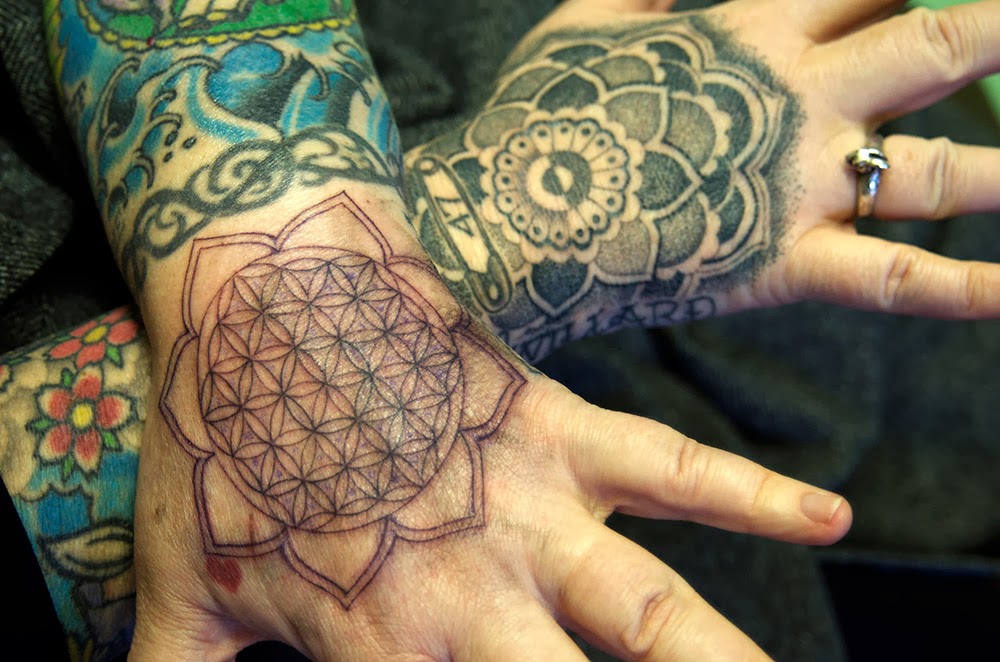
Hot off the presses! Amy got tattooed earlier this evening, and I decided to post the photos. I don’t think any of the previous entries on the blog are photos I shot the day the entry was posted.

Here Danny and Amy are getting ready to start:

Nikon D7000, 35mm (35-80), 1/80, f/4.2, ISO 400, adjusted

And here’s the new work partway done, with the lines complete but the shading dots yet to come:

Nikon D7000, 48mm (35-80), 1/40, f/4.5, ISO 800, adjusted

Just so there’s actually a technique lesson here, I can use a narrow depth of field to change the story I’m telling. In this shot the emphasis is on the work in progress:

Nikon D7000, 80mm (35-80), 1/125, f/5.6, ISO 900, adjusted

But by changing the focus just a bit, I switch to a more subtle emphasis. Here Danny is the in-focus subject, even though he appears in the shot only in silhouette:

Nikon D7000, 80mm (35-80), 1/125, f/5.6, ISO 900, adjusted


Wednesday, November 13, 2013

State Fair - Midway miscellany

Nikon D7000, 48mm (28-200), 1/125, f/4.5, ISO 800

The best part of the fair – for kids and photographers alike – has to be the midway. As the sun goes down, the rides and booths become a festival of fascinating images. They also become a festival of tricky technical challenges.

This close-up of a trash can lid gets in tight to reduce the face to abstract form and color. It also brings out the surface texture and the glittery paint.

Nikon D7000, 135mm (28-200), 1/1250, f/7.1, ISO 800

The colors everywhere were wonderful. Booths full of stuffed animal prizes provided no end of bright patterns.

Nikon D7000, 200mm (28-200), 1/125, f/5.6, ISO 800, cropped

As usual, I had two cameras with me. I put a fisheye lens on my D3000, but I didn’t use it anywhere near as often as I expected to. Here’s one spot where it produced a good result:

Nikon D3000, 10.5mm, 1/80, f/2.8, ISO 400

I took two photos of this basketball booth, one from the front and one from the back. This one proved to be the more visually interesting of the two, the strong backlight giving the scene an almost ghostly feeling.

Nikon D3000, 10.5mm, 1/80, f/2.8, ISO 800

As usual, I found that when I carefully planned shots that I ended up with something completely unexpected. My plan was to shoot this large ride with a slow shutter speed, letting it paint long streaks of light in my image (as I did with the Scrambler). Though I got a few shots that captured what I was aiming for, I ended up liking this relatively still image the best. I loved the strange combination of table lamp and War of the Worlds Martian death machine. I also liked the blue color the lights spread over the whole image.

Nikon D3000, 10.5mm, 1/20, f/4.0, ISO 800

When I first started editing the State Fair photos, I didn’t care much for this one. But Amy liked it, so I gave it a chance. And she was right.

Nikon D7000, 28mm (28-200), 1/60, f/5.6, ISO 800, cropped

My initial objection was that the lights in the background were blurry. But that lends the scene a quality in which the prosaic foreground full of vendors is set apart from the dreamlike realm of the midway.


Wednesday, November 6, 2013

State Fair - Portraits 3

Nikon D7000, 56mm (28-200), 1/60, f/4.5, ISO 800, adjusted

As I mentioned somewhere in the distant past – back at the start of the Missouri State Fair adventure – the experience is hard to beat for people watching. Thus it’s also hard to beat for candid photo ops. I think I’m going to let these pictures speak for themselves.

Nikon D7000, 92mm (28-200), 1/60, f/5, ISO 800, adjusted

Nikon D7000, 78mm (28-200), 1/1000, f/6.3, ISO 800, adjusted

Nikon D7000, 86mm (28-200), 1/160, f/5, ISO 800, adjusted

Nikon D7000, 62mm (28-200), 1/400, f/5, ISO 800, adjusted

Wednesday, October 23, 2013

State Fair – Portraits 2

Nikon D7000, 28mm (28-200), 1/60, f/11, ISO 800, adjusted

Part of the trick with street photography is to capture candid, un-posed moments. But sometimes one must sacrifice spontaneity in order to get the shot.

Here’s an example: I spotted a man sporting an interesting tattoo: Elvis Presley’s famous “Taking Care of Business in a Flash” emblem. I couldn’t get a good angle on him, so I gave up on him and moved on. But then I mentioned the tattoo to my wife, and without a moment’s hesitation she caught up with the guy and asked if we could take his picture.

He was really nice about it. Turns out he used to be an Elvis impersonator, and he was happy to pose for a couple of shots.

Of course the result looks posed. But it’s a pose that conveys the tattoo and the personality of the man with the ink. Sometimes ya gotta bend the rules.

Technical note: the slow shutter speed caught a little motion on the subject’s left hand, which gave a good sense of energy to an otherwise static shot.

Wednesday, April 17, 2013

Ethnic Fest 2013

Nikon D7000, 200mm (28-200), 1/60, f/5.6, ISO 640, adjusted
Last Saturday I took some shots at the college’s annual Ethnic Festival. I try to time the Saturday photography seminar I teach once a semester to coincide with an event like this with some good photo opportunities. This year we missed the dance groups, so photogenic moments were fewer and farther between.

The one thing I forgot from last year was that the light in the field house is deceptively bad. It looks okay to the eye, but it’s dim enough to make a camera struggle. The shot at the top of this post was far too dark straight out of the camera:

Nikon D7000, 200mm (28-200), 1/60, f/5.6, ISO 640
And that was at a relatively slow, 60 shutter. Fortunately, fixing that particular picture was an easy level adjustment in Photoshop.

When I slowed it down further, however, the lighting got better but other problems cropped up. A 30 shutter is about as slow as I can go and not pick up camera vibration. And even then, I have to concentrate on holding the camera still. If I pay attention to my grip, I end up only with motion from the subject (though at this slow speed even that will show up in the picture):

Nikon D7000, 200mm (28-200), 1/30, f/5.6, ISO 1000
But if I’m not careful, the camera moves and the whole picture gets messed up:

Nikon D7000, 200mm (28-200), 1/30, f/5.6, ISO 1000
In retrospect, I should have cranked the ISO up a bit more and found ways to adjust for the resulting graininess.

Wednesday, March 20, 2013

St. Pat’s parade

Nikon D7000, 92mm (Tamron 28-200), 1/250, f/5.6, ISO 320

Last Sunday Ken and I shot pictures at the St. Patrick’s Day parade in Lawrence. Thanks in part to the inclement weather and in part to the lackluster parade participants, I found myself more visually interested in the crowd. In particular, some folks brought a three-legged dog who appeared to be having more fun than any of the humans in the vicinity.

Most of the parade itself was standard stuff:

Nikon D7000, 112mm (Tamron 28-200), 1/160, f/9, ISO 400

Nikon D7000, 116mm (Tamron 28-200), 1/250, f/5.3, ISO 400, cropped

Nikon D7000, 170mm (Tamron 28-200), 1/500, f/5.6, ISO 800, cropped

Wednesday, February 27, 2013

Snowpocalypse

Nikon D7000, 29mm (18-55), 1/3 sec., f/10, ISO 100

So last week it snowed. And snowed. And snowed. Classes were cancelled for two days, leaving me with plenty of photo time on my hands.

The picture above was taken from a spot near the location of last week’s night shot. Having learned my lesson about snowflakes on the lens, I used a hood this time. As in previous efforts, the long exposure necessary to capture the light causes the falling snow to turn into more of a mist in the photo.

Nikon D7000, 48mm (18-55), 1/160, f/6.3, ISO 200

Didn’t take long for the snow to get deep. Here the big, ploppy flakes show up well against dark objects in the background.

Nikon D7000, 30mm (18-55), 1/60, f/4.5, ISO 560

We were doing quite a bit of business at the bird feeder. This picture is less of a planned photograph and more of a quick snapshot through a window with the camera’s settings on auto. Still, I like the way it turned out. I’m particularly fond of the birds caught in mid-flight around the feeder.

Nikon D7000, 55mm (18-55), 1/50, f/36, ISO 100

I love the tiny points of light that shine in the middle of a smooth patch of snow. Even at dawn the sunlight was already quite bright, so I closed the aperture down as far as it would go and worked with a slower shutter speed to bring out the light points.


Nikon D7000, 35mm (18-55), 3 sec., f/8, 100 ISO, retouched

And then Snowpocalypse Two hit less than a week later. Here’s another early morning shot taken with a long shutter speed and a hood to keep the snow off the lens. I also retouched it in Photoshop to make it slightly less orange.

Nikon D7000, 32mm (18-55), 3 sec., f/8, 100 ISO

Just for fun, I decided to add a flash to the long exposure. The objects in the background are too far away for the flash to reach them, but the falling snowflakes closer to the camera bounce it back nicely. The blue color is a result of the camera trying to white balance for the flash. Though I hadn’t anticipated it, I like the effect.

Saturday, December 29, 2012

2012’s unblogged favorites – #3: Low rider

Nikon D3000, 10.5mm, 1/320, f/9, ISO 100

Overall the Maker Faire didn’t turn out to be as photogenic as I’d hoped. The crowd was huge, making it hard to get shots without a gaggle of gawkers standing between camera and subject. Most of the exhibits tended to be slow-moving robots, electronic doodads, tables covered in tschotchkes and other non-photogenic fare. However, the experience yielded a handful of good shots, such as this colorful photo of a car. The picture has proved useful in my Photoshop class, where I’ve used it to help teach color adjustment using channels.

Unfortunately, it also demonstrates how tricky it can be to keep yourself out of a fisheye photo. You can see the shadow of my head in the lower right-hand side of the shot.

Wednesday, November 21, 2012

Day of the Dead

Nikon D7000, 55mm (18-55), 1/30, f/13, ISO 100

These dancers at the Topeka Day of the Dead celebration moved a lot. Thus getting the right shot required either frozen motion or – as in this shot – motion blur. A good motion blur shot requires a slow shutter, a steady hand and just the right mix of motion and stillness. Of all the shots I took that afternoon at slower speeds, this one came closest to the perfect combination of elements.

Notice that the background and the figure lying in the street are all still. A blurry background screams “I can’t hold my camera still,” but here I don’t have that problem. The dancers are blurred in ways that communicate their motion. The guy in blue is obviously either standing up or squatting down. The woman to the right is frozen except for her rapidly-moving arm.

But the best motion is on the skull-faced woman in the center of the shot. Her head is in circular motion, freezing her face (thus giving good facial detail) and getting a strong sense of rotating motion from her feathers.

Wednesday, September 26, 2012

Playing with fire

Nikon D7000, 18-55mm lens at 30mm, shutter 250, f/8, ISO 100, cropped

Awhile back I was at a Chamber of Commerce presentation (don’t ask) waiting for a speech to begin when I happened to overhear a conversation between two photographers. One was boasting about how he knew photographers who shot hundreds of pictures and only got a handful of good ones, while he carefully picked his shots and got great pictures more than half the time.

In general I could take the boasting, at least in part because later I noticed that he had his flash at a 45-degree angle on a 20 foot high, irregular ceiling. In a future entry I’ll explain why that doesn’t work. The part of the boast that bugged me was the notion that great photographers get great photos every time they hit their shutter buttons.

Not so. For starters, even an experienced photographer can mess things up (see last week’s entry for proof). But more than that, one of the great beauties of digital photography is that it frees us from the obligation to be stingy with our shots.

A recent “photo safari” to the Renaissance Festival is a case in point. In all I shot more than 1600 pictures, including more than 340 of the troupe in this photo. Back in the film days, that would have been between 45 and 67 rolls of film, including the expense of buying it and the hassle of developing it. Just carrying that much stuff around the RenFest would have been a prohibitive proposition.

If I’d been forced to carefully pick and choose every shot I took, I could still have expected to get a few good pictures. But my chances of catching the exact moment when a fire trick looked like mushroom clouds? Odds would have been against it.

That’s why I encourage my students to shoot everything that moves and most of what doesn’t. This introduces the spontaneous into your work. You get the chance to catch anything you can see, all the moments that will escape if you feel obliged to dither about whether or not the shot is worth shooting.

Wednesday, August 1, 2012

The Ethnic Fest

Nikon D3000, 26mm (18-55mm), f/6.3, shutter 1/8, ISO 200

The Wyandotte County Ethnic Festival is an event full of energy and motion. Video cameras have no trouble capturing motion, but still photographers have to be a bit more clever about it.

One of our two options is motion blur. Allowing the subject to move during the exposure creates a blurry, streaky image the viewer will read as motion. The key is shutter speed. The shutter must remain open long enough for the subject to move.

In this example, a group of dancers are making their way to the stage. I’ve got the ISO set at 200, which is a little low for most indoor lighting situations. As a result, the shutter needs to stay open for a long time (1/8 of a second) in order to get enough light for a good exposure. The dancers moved a fair amount while the shutter was open, resulting in a nice motion blur effect.

But motion blur can be tricky. You only want blur on moving subjects, not the picture as a whole. The subjects can move, but the camera can’t. If your hands move at all (even as much as the pressure of your finger on the trigger) while shutter is open, it will blur your entire image and make it look terrible.

In this example (shot just a second or two before the good one above), the camera moved just a teeny bit, wrecking the image quality.

Nikon D3000, 26mm (18-55mm), f/6.3, shutter 1/8, ISO 200

Thus to pull off motion blur you will generally want a tripod, monopod or something else to brace your camera.